
Harnessing AI Productivity: Enterprise Code Quality and Security with SonarQube

已更新:8月31日

The breakthrough development of generative AI technology in recent years has fundamentally transformed software engineering workflows. However, as enterprise organisations strive to accelerate delivery, they face a critical challenge: ensuring that AI-generated code maintains acceptable levels of security, reliability, and maintainability.
As development velocity scales exponentially, organisations must establish modern detection mechanisms suited to the AI era. Failing to do so risks an uncontrollable accumulation of software vulnerabilities and technical debt.
| Productivity Gains and Hidden Risks of AI Coding Assistants
When development teams rely excessively on AI coding assistants, the primary risks involve hallucination and code review overload. Although AI-generated code often appears syntactically correct on the surface, it frequently hides structural flaws or security vulnerabilities that violate enterprise standards.
Inflation of Technical Debt: Over-reliance on AI leads to highly repetitive, unnecessarily complex functions and poor code readability. Consequently, this hidden technical debt significantly increases future maintenance costs and refactoring complexity.
Logical Flaws Stemming from Hallucinations: AI engines frequently produce code that functions under standard conditions but triggers critical system crashes during edge cases. Without rigorous static analysis, manual code reviews rarely detect these subtle logical defects.
| Zero-Trust Code Governance: The AI Code Assurance Strategy
To manage the volume of AI-generated code entering production pipelines, SonarQube enforces the AI Code Assurance framework. Built upon zero-trust principles, this framework utilizes an objective Static Application Security Testing (SAST) engine to establish automated Quality Gates before code merges into the core repository.

Core Capability | Enterprise Challenge Addressed |
Identify | Automatically flags projects containing AI-generated code to eliminate blind spots and enable centralised risk management on a unified dashboard. |
Analyse | Uses advanced taint analysis and data flow tracking to pinpoint hidden security vulnerabilities and architectural defects missed by manual reviews. |
Enforce | Mandates deterministic Quality Gates to establish a unified automated blocking mechanism against unstable AI outputs. |
Signal | Delivers compliant review reports aligned with developer standards to ensure software released to production meets enterprise-grade security benchmarks. |
| AI CodeFix: From Contextual Insights to One-Click Remediation
Beyond risk mitigation, SonarQube embeds AI capabilities directly into its detection engine, converting passive defence into proactive remediation. Traditional static analysis tools merely offer error reports and documentation links, requiring developers to spend substantial time diagnosing issues. SonarQube's AI CodeFix streamlines this process through three primary capabilities:
Context-Aware Precise Remediation: Upon detecting code flaws or security vulnerabilities, AI CodeFix evaluates overall project architecture to generate ready-to-apply remediation code directly.

Controlled AI Generation Without Remediation Hallucinations: Unlike unconstrained queries submitted to public AI models, SonarQube’s AI recommendations remain strictly bounded by underlying static analysis rules. Therefore, suggested fixes resolve vulnerabilities without corrupting existing business logic, substantially reducing secondary errors.
Accelerating Developer Growth: When handling complex AI-generated code, SonarQube provides both code fixes and clear explanations of underlying root causes. As a result, development teams continuously upgrade their security awareness while resolving codebase issues.

| Advanced AI Ecosystem Expansion in Sonar
To support forward-looking enterprise organisations aiming to maximize automation, the Sonar ecosystem offers expanded AI integration capabilities across the software development lifecycle:
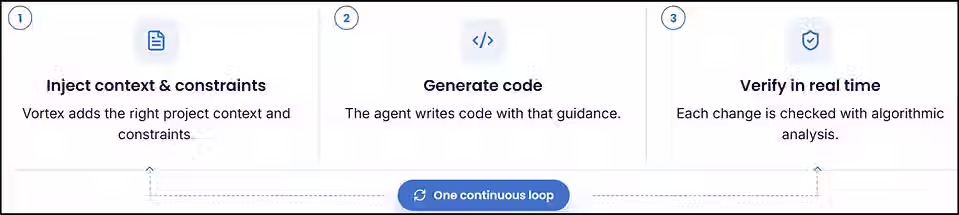
Sonar Vortex (Shift-Left Protection at the Source): Utilising the Model Context Protocol (MCP), Sonar Vortex connects Sonar standards directly to AI agents such as Cursor and Claude. Consequently, AI agents write code with full enterprise context and perform real-time self-validation, achieving compliance during active development.
Gitar (Automated PR Review and CI Debugging Assistant): Operating at the Pull Request stage, Gitar automatically generates PR summaries and inline code recommendations. Furthermore, when CI builds fail, Gitar identifies root causes and submits corrective code commits automatically, relieving senior team leads of review pressure. Engineers can also engage in interactive dialogues with Gitar to refine logic, turning code reviews into collaborative engineering.

| Conclusion
Generative AI continues to accelerate software development velocity and undertake larger writing tasks. To manage this shift, enterprise organisations require a governance platform that integrates into existing workflows, offers objective validation, and assists in automated remediation.
Through SonarQube’s Quality Gates and AI assurance mechanisms, organisations achieve an optimal balance between rapid deployment and uncompromising software security.
Contact the DevOps Tec consulting team today to schedule a complimentary, customized demonstration tailored to your enterprise infrastructure.

![[Sonar] Building Secure and Reliable AI Code Workflows with Sonar](https://static.wixstatic.com/media/f087dc_50695d6077184281a18939ea3fae9df9~mv2.png/v1/fill/w_980,h_514,al_c,q_90,usm_0.66_1.00_0.01,enc_avif,quality_auto/f087dc_50695d6077184281a18939ea3fae9df9~mv2.png)
![[SonarSource]: The Top Choice for Code Quality and Security Management](https://static.wixstatic.com/media/f087dc_6e1ed034f951442e8cef6c07193189e0~mv2.png/v1/fill/w_980,h_514,al_c,q_90,usm_0.66_1.00_0.01,enc_avif,quality_auto/f087dc_6e1ed034f951442e8cef6c07193189e0~mv2.png)
留言